Wednesday, 18 March 2015

Syria Civil Defence ‘White Helmets’ call for No-Fly Zone following chemical attack


Above images via Syria Solidarity UK: 17th March London protest outside the US Embassy following new Assad regime air attacks with chlorine bombs.

There will be a further protest outside the US Embassy this Sunday, 2-4pm. Facebook event page here.

Note that last Saturday’s march to Downing Street also called for a No-Fly Zone.

Following the 16 March attacks, Syria Civil Defence, also known as the White Helmets, have called for the imposition of a no-fly zone in Syria to stop further air attacks on civilians by the Assad regime.You can sign a petition in support on their website, www.whitehelmets.org.

Press release from The Syria Campaign:

FOR IMMEDIATE RELEASE
17th March 2015

CONTACT:
Bissan Fakih, bissan@thesyriacampaign.org, +961 71 377 364

SYRIAN RESCUE WORKERS REPORT THE USE OF CHLORINE GAS IN BARREL BOMB ATTACKS ON CIVILIANS IN IDLIB

Syrian Civil Defence call for the UN Security Council to impose a no-fly zone

Chlorine attacks took place in the town of Sarmeen and in the village of Kminas on Monday night. Kminas was hit by two chlorine-filled barrel bombs around 8:30 PM. The village is nearly deserted and no casualties were recorded. The smell of chlorine traveled west to the town of Sarmeen. Members of the Syrian Civil Defence – known as the White Helmets – responded to civilians who complained of choking but there were no serious casualties.

At 10:30 PM, the town of Sarmeen was hit with chlorine-filled barrel bombs. Six people are confirmed to have died in the attack. A husband and wife and their three children, and the husband’s mother. They are reported to have died in the field hospital due to lack of treatment options available.

Five civil defence centres responded to the attacks in Sarmeen – teams from Binnish, Maarat Nauman, Saraqeb, Balyon and Sarmeen were present. There were more than 70 cases of choking, including seven members of the White Helmets who were later discharged from the hospital around 2 AM. Some of the injured have been taken to Turkey for treatment, others have remained to be treated in field hospitals.

The government renewed their attacks two hours later in Kafr Takharim, using scud missiles. Seven were killed.

The chlorine attacks come just eleven days after the UN Security Council adopted a resolution specifically condemning the use of the gas as a weapon in Syria. Resolution 2209 [2015] – drafted by the United States – states that the UN Security Council will impose measures under Chapter VII of the UN Charter if chemical weapons including chlorine are used again. Chapter VII allows decisions to be enforced with economic sanctions or military force.

In response to the chlorine attack, the White Helmets are calling for the United Nations to uphold its demands and stop the chemical attacks and barrel bombs by implementing a ‘no-fly zone’ in Syria. Raed Saleh, head of the Syrian Civil Defence said:
“When a child inhales chlorine they get a burning pain in their throat and eyes and they feel like they’re suffocating. Sometimes they vomit but often their breathing just gets shallower and they slip away, never to wake up again. It breaks your heart forever. I wish the world could see what I have seen with my eyes.”

He added:
“These children did not have to die. It’s not good enough for the United Nations to ban these chemical weapons on paper, they need to stop them from dropping from the sky. With a no-fly zone these children would be alive today.”

The White Helmets have launched their campaign for today at www.whitehelmets.org, in partnership with global advocacy group The Syria Campaign. James Sadri, Campaign Director of The Syria Campaign said:
“Only days ago the UN Security Council said it would impose Chapter VII measures if its resolution on chemical weapons was violated again. Well it’s been violated. Real action must be taken immediately to protect civilians – with a no-fly zone if necessary.”

Video: English language video of the Syria Civil Defence treating victims of the attacks
https://www.youtube.com/watch?v=dmvVJYQGKnM&t=90

Video: A rescue worker shows signs of intoxication
https://youtu.be/gPa_6CoYD_o


Notes to Editors

The Syrian Civil Defense – or the ‘White Helmets’ as they are known – are volunteer rescue workers who arrive to the sites of barrel bomb attacks to dig survivors out from under the rubble and transport the injured to safety. Unarmed and neutral, they have saved people from all sides of the conflict.

Barrel bombs themselves were banned last year in a separate UN Security Council resolution 2193 on 22 February 2014. However, since then according to the Syrian Network for Human Rights at least 1,892 children have been killed by them.
http://sn4hr.org/wp-content/pdf/english/Barrel_Bombs_2015_en.pdf

Resolution 2209 was passed after a fact-finding mission of the Organisation for the Prohibition of Chemical Weapons (OPCW) earlier this year concluded “with a high degree of confidence” that chlorine was used on three villages in Syria in 2014, killing 13 people. The report included eyewitness accounts of helicopters dropping barrel bombs with toxic chemicals. The use of chlorine gas has been repeatedly reported by activists and rescue workers in Syria.

In the OPCW report they did not say which side was responsible for the chlorine attacks, but the UK, France and US have all accused the Assad regime of the attacks. Addressing the Security Council, the US ambassador to the UN, Samantha Power, said there was not much doubt. “Let’s ask ourselves, who has helicopters in Syria? Certainly not the opposition. Only the regime does and we have seen them use their helicopters in countless other attacks on innocent Syrians using barrel bombs.”

The Syrian representative to the UN has persistently denied the use of chlorine gas and in a BBC interview in February Assad said that his regime were “definitely not” using chlorine as a weapon.

The Syria Campaign is an advocacy group mobilising public support around the world to stop the violence in Syria

Saturday, 14 March 2015

Four years is too long


Last year, two out of every five civilians killed in Syria were killed by Assad’s air attacks.

Over half the women killed last year were killed by Assad’s air attacks.

Over half the children killed last year were killed by Assad’s air attacks.

There is no other single measure that could do as much to save civilian lives as stopping Assad’s air force.

Some say this should be done by giving the Free Syrian Army anti-aircraft weapons. That might help, but not enough. Not enough to stop Assad’s bombers. There are too many. They attack over too wide an area. They fly too high.

So the best way, the one way, the only way to ground Assad’s air force, is for the UK, France, the USA, one or all of them I don’t care, to make the decision.

Make the call.

Tell Assad this stops now. Tell him, your bombing stops now or we start hitting your air bases. UK, France, USA, ground Assad’s air force.

Four years is too long.

Syria needs a No-Fly Zone.

Join us today in London.


Saturday, 7 March 2015

Comparing Syria to DR Congo

The war in Syria is very different to the recent wars in the Democratic Republic of Congo, yet comparisons are occasionally made for whatever reason. In a January 2013 interview, President Obama brought up conflict in the DRC when contextualising his decision-making on Syria:
In a situation like Syria, I have to ask, can we make a difference in that situation? Would a military intervention have an impact? How would it affect our ability to support troops who are still in Afghanistan? What would be the aftermath of our involvement on the ground? Could it trigger even worse violence or the use of chemical weapons? What offers the best prospect of a stable post-Assad regime? And how do I weigh tens of thousands who've been killed in Syria versus the tens of thousands who are currently being killed in the Congo?

Those are not simple questions. And you process them as best you can. You make the decisions you think balance all these equities, and you hope that, at the end of your presidency, you can look back and say, I made more right calls than not and that I saved lives where I could, and that America, as best it could in a difficult, dangerous world, was, net, a force for good.

As Michael E. O’Hanlon pointed out at the time, Congo presented a very different case to Syria. Most of the deaths were being caused by malnutrition and poor healthcare, not directly by violence. A UN peacekeeping mission was in place, and had been since 1999. The US had been involved in training the DRC’s military since 2009, though with mixed results.

Michael E. O’Hanlon argued that there was certainly more that the US could usefully contribute, but that the DRC conflict was much less violent than those the US had faced in Afghanistan and Iraq, and also that conditions in Syria and the DRC were quite different, so that even if the US decided to commit forces in both places, the kinds of forces each would require would not be the same, and so there would be few if any conflicting demands from the two missions.

So different are the problems in Syria and the Democratic Republic of Congo that it’s hard to believe the President was raising the DRC in his Syria answer as a genuine concern; it seems to have been more of an attempt to use Congo’s problems as a rhetorical diversion. This is what is known as ‘whataboutery’.

Thursday, 5 March 2015

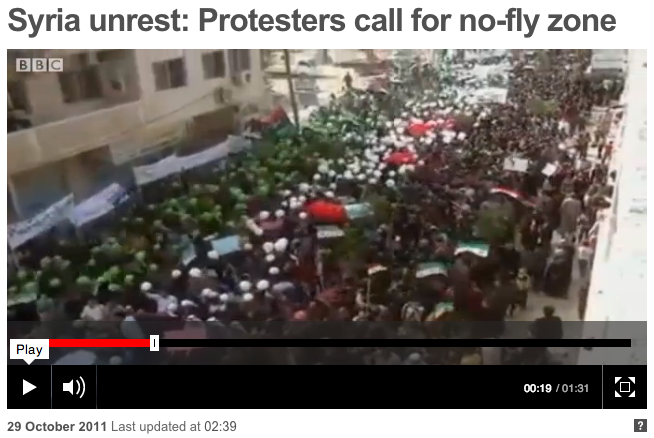
Syrians first called for a No-Fly Zone in October 2011

Syrians first called for a No-Fly Zone in October 2011—that call needs your solidarity today.

Join the 4th Anniversary march for Syria in London on Saturday 14th March and call for a No-Fly Zone for Syria.

Assembly point: Marble Arch, Hyde Park, at 12:30.
End point: 10 Downing Street.


Monday, 2 March 2015

London 4th Anniversary Syria demonstration calls for No-Fly Zone

Cross-posted from Syria Solidarity UK.

Facebook event page.

4th ANNIVERSARY OF THE SYRIAN REVOLUTION

Assembly point: Marble Arch, Hyde Park, at 12:30 Saturday 14th March.
End Point: 10 Downing Street.

Join us on March 14th in London to show your solidarity and support for a peaceful, democratic Syria: a Syria without Assad and a Syria without ISIS.

It is more important than ever to show your support. More than half of Syria’s people have been displaced. Millions have fled the country. Over 200,000 people have been killed. Over 250,000 are still in regime prisons.

Syrians have been tortured, shot, bombed, starved, and gassed. Lend your voice to demand action. We cannot let the world turn its back on Syria.

SOLIDARITY WITH THE SYRIAN PEOPLE

The Syria Solidarity Movement UK is a network of activists, academics, trade unionists, socialists, lawyers, doctors, nurses, students, committed to solidarity with the Syrian Revolution.

We aim to provide political and material solidarity for the people of Syria. We want to work with all existing campaigns and progressive organisations to help in the struggle for a democratic and free Syria.

SYRIAN REFUGEES WELCOME HERE

There are over 4 million Syrian refugees, 94% of them in Jordan, Turkey, Lebanon, Iraq and Egypt. The UK government has accepted only 90 of the most vulnerable Syrian refugees for resettlement, while at the same time they have pulled out of EU rescue efforts in the Mediterranean.

We call on the UK government to:
  • Expand the Vulnerable Persons Relocation Scheme
  • Contribute to expanding Operation Triton for Mediterranean rescue
  • Work with the EU to allow safe routes for Syrians entering Europe

A NO-FLY ZONE FOR SYRIA

We call on UN Security Council permanent members UK, France, and USA, to:
  • Protect Civilians
  • Enforce UN Security Council Resolution 2139
  • Stop Assad’s air attacks – Syria needs a No-Fly Zone

Tuesday, 10 February 2015

Wear a good suit and deny everything

Anyone who has followed the Syria war in any detail, even from a secure distance in the UK, will have seen things they would rather not have seen. Photographs of tortured, starved, lacerated, or burned bodies; images of children with limbs gone, or jaws half blown off, or heads completely blown off. For me, the presence in memory of these indelible images made the thought of watching Assad calmly answering questions on the BBC as unsettling a prospect as watching a YouTube clip of the aftermath of a marketplace bombing.

We know the routine by now: a book-lined office signalling a stable, secular, civilised, Western-friendly leader. A good suit signalling a man we can do business with. And then deny everything.

Deny the Human Rights Watch reports, the UN reports on barrel bombs, on chemical weapons, on the blocking of food aid, on the blocking of medical aid. Deny every single thing.

Jeremy Bowen politely challenged Assad with a series of reports of regime crimes. He quoted from a Human Rights Watch report of 30th January saying that Assad’s forces “deliberately and viciously attacked civilians in opposition-held areas” using indiscriminate weapons, most notoriously barrel bombs. Assad dismissed it as a “childish story” denying that the regime uses barrel bombs or any other indiscriminate weapons. (7:25)

Jeremy Bowen persisted, citing Staffan de Mistura, United Nations and Arab League Envoy to Syria, on the “constant fear of barrel bombs.” Assad continued to deny the regime targeted civilians saying “there is no logic in it.” (8:51)

Jeremy Bowen refused to accept Assad’s denial of barrel bomb attacks, saying “it does happen,” and asked why he doesn’t stop such attacks to improve his international standing. Assad continued to deny even the existence of barrel bombs. (10:35)

Jeremy Bowen asked him about the recent OPCW report on chlorine attacks. Again Assad not only denied responsibility for the chlorine attacks, he seemed to even deny that there had ever been any chemical weapons attacks in Syria. (11:36)

When Jeremy Bowen asked about civilian neighbourhoods under siege by the regime, Assad denied that any civilians are present in those neighbourhoods. (19:28)

When Jeremy Bowen pointed to the regime restricting medical supplies to civilians in rebel-held areas, citing Elizabeth Hoff of the World Health Organisation, Assad denied it, saying the regime supplies ISIS-held Raqqa with food and medical supplies, so why wouldn’t they supply other areas? (20:38)

Jeremy Bowen quoted a statement to the UN Security Council by Valerie Amos, head of UN OCHA, on the regime’s blocking of a majority of UN aid convoys to besieged areas. Assad called it an “unrealistic un-objective statement,’ saying “we cannot discuss it as fact, this is part of the propaganda against Syria for the past four years.” (21:18)

Is there anything said by a Western leader that he agrees with? Is there any reporting on Syria that he agrees is true? Here are two things he clearly liked hearing from the West…

Assad: “Obama answered your question when he said few month ago that waiting for or depending on what they called the so-called moderate opposition was a ‘fantasy’.” (5:10)

Assad: “Even in the Western media now they are talking about the ISIS and Al Nusra and Al Qaeda affiliates organisation and groups prevailing.” (5:38)

Obama’s miserable “fantasy” comment, made in contradiction to his own declared policy, should shame him as it is spewed back from Assad’s mouth. It should shame Obama just as should his narrow intervention against ISIS when Assad is the party that continues to be by far the biggest killer of Syrian civilians.

In this interview Assad has once again shown himself to be incapable of any acknowledgement of responsibility, of any recognition of reality. He is not someone the West can do business with. The greatest fantasy on Syria has been the hope that diplomacy could trump force. This war can’t end as long as Assad is allowed the means to slaughter at will.

On the 22nd of this month it will be three years since journalists Marie Colvin and Rémi Ochlik were killed by Syrian regime shelling in the siege of Baba Amr, Homs. According to fellow journalist Paul Conroy, severely injured in the same attack, the media centre they were staying in was deliberately targeted by Assad’s forces bracketing their shellfire in order to achieve a direct hit.

And on the 22nd it will also be one year since the UN Security Council passed Resolution 2139, which demanded amongst other things an end to sieges of civilian areas, an end to shelling of civilian areas, and an end to air attacks on civilian areas, including an end to barrel bombing.

Every 30 days since the passing of UNSCR 2139, the Secretary General has been required to report to the Security Council on compliance. Every report has listed ongoing sieges, ongoing shelling of civilians, ongoing air attacks on civilians.

UNSCR 2139 ended with the Security Council expressing “its intent to take further steps in the case of non-compliance with this resolution.” Since then Russia has made clear it will block any substantial measures to enforce compliance. The Security Council is in a similar position as it was over Kosovo in 1999, having made demands but being unable to pass a vote for enforcement of those demands.

One year on from the passing of that resolution, individual permanent members of the Security Council now need to recognise that there is no prospect of a diplomatic solution with Assad. Consequently there is no prospect of relief for civilians unless they follow the Kosovo precedent and take responsibility to enforce Resolution 2139.

Tuesday, 3 February 2015

Minimum of 25,428 civilians killed since Commons vote – true number may be over 44,400


The Violations Documentation Center in Syria now lists 25,428 civilians killed since the 29 August 2013 UK Parliament vote against intervention.

This total includes 234 civilians killed by rebels listed under ‘Regime’ casualties. 25,194 are listed under ‘Martyrs’, a figure which includes 165 killed by US-led Coalition air strikes, leaving 25,029 civilians killed by the regime or others.

VDC figures are a minimum count of people confirmed killed, and as omniscience is impossible in wartime they are certain to be an undercount. When compared to the latest UN minimum count of 191,369 confirmed violent deaths (both civilians and combatants) up to the end of April 2014, VDC figures for the same period show only 109,585 killed. (95,143 under ‘Martyrs’ and 14,442 under ’Regime’.)

If the VDC figure for civilians killed since the 2013 vote were found to be an undercount to the same degree, then the actual figure would be over 44,400 civilians killed since the UK Parliament rejected intervention.

Amongst the 25,428 civilians VDC Syria confirmed killed since the UK vote are 9,557 people killed by air attacks. 165 of them were killed by US-led strikes, and 9,392 were killed by Assad’s air force. That means at least 36% of all civilians confirmed killed since the vote could have been saved by a No-Fly Zone. Again, the confirmed number is certainly an undercount, possibly by thousands.

UNHCR numbers for registered refugees are also lower than the actual number of people believed to have fled Syria. When the UK Parliament debated intervention on the 29th of August 2013 the number of registered Syrian refugees was 1,830,557. The current number of registered refugees is 3,726,884, over twice as many, but the true number will be higher still.

Air attacks by the regime are a key driver of refugee flows: see Barrel Bombs: A tool to force displacement in Eastern Aleppo by Ryan O’Farrell, and the March 2014 Human Rights Watch report, Unlawful Air Attacks Terrorize Aleppo. This month will see the first anniversary of UN Security Council Resolution 2139 which demanded an end to air attacks on civilian areas, amongst other things. It has not been enforced.

Protect Civilians
Enforce UN Security Council Resolution 2139
Syria needs a No-Fly Zone


In giving these numbers, I am trying to demonstrate the scale of the consequences of the decisions made by MPs in August 2013. I have not shown graphic images of the butchery that continues every day, but you should remember that these are not peaceful deaths, eased by painkillers in quiet hospital beds. And for every body fatally ripped apart there are untold others maimed for life. And they all have names, or had them once.

Below are the confirmed killed for one day, 25 December 2014.

Click to enlarge.


Monday, 2 February 2015

The greater evil

Image by The Syria Campaign based on VDC Syria data
With the murder of journalist Kenji Goto, ISIS again demonstrated their carefully packaged and branded approach to terrorism, from logo to costumes, from the attention-grabbing trailing of their murders to their ‘please share’ death videos, they present perhaps the most compelling integration of marketing and political violence since the Nazis. They are the perfect terrorists from Central Casting.

But while ISIS flaunt their brutality, the greatest threat to Syrians, and consequently the greatest threat to regional stability and to European security, remains the Assad regime. In December, the Assad regime was responsible for three-quarters of all violent deaths recorded by the Syrian Network for Human Rights. Amongst civilians the proportion was even higher: over 85% of civilians killed in December were victims of the Assad regime. The Regime is responsible for over 95% of all civilian violent deaths recorded by the Violations Documentation Center in Syria since March 2011. According to VDC figures, in the last year in the province of Raqqa, stronghold of ISIS, over seven times as many civilians were confirmed killed by Assad air strikes as were killed by ISIS.

Like ISIS, Assad also has a marketing strategy. Unlike ISIS, his strategy is not to flaunt his brutality, at least when dealing with the wider world beyond Syria. From before ISIS appeared, from the very start of peaceful protests against his dictatorship in 2011, he has claimed that all of his opponents are terrorists and has sought to portray himself as the opposite: a civilised leader in a Western businessman’s suit and tie. The contrast between his costume and those of ISIS is perfect… almost too perfect.

For years there have  been allegations from former insiders that the Assad regime deliberately brought about the rise of ISIS: from Nawaf Fares, former Syrian ambassador to Iraq; from Mohammed Habash, former member of the Syrian parliament; from Bassam Barabandi, former Syrian diplomat; from a former member of Syria’s Military Intelligence Directorate.

The regime had a known history of facilitating their earlier incarnation, Al Qaeda in Iraq, and there is objective evidence that the regime avoided conflict with ISIS as they took over territory from the Free Syrian Army and associated rebel groups. Despite this, Assad’s marketing of himself as a force to counter terrorism has had an unreasonable degree of success.

It’s sadly no longer surprising when Patrick Cockburn in the Independent pitches the topsy-turvy notion that keeping Assad might help counter terrorism, nor when we see it coming from Leslie Gelb writing for the Daily Beast website – he has pushed this line before. The disturbing thing is that Gelb now claims anonymous sources in the Obama administration are telling him that Obama also buys this line. Seeing it echoed in a New York Times editorial makes it even more unsettling as the New York Times editorial board has for some time been a prime target of Obama administration PR efforts. For more on reactions to this, see Akbar Shahid Ahmed’s report, Springtime for Assad.

Assad may have hoped that his recent interview with Foreign Affairs magazine would be the perfect culmination of his pitch as Syria’s man of reason, a secular leader the West can do business with; but Jonathan Tepperman, the journalist who conducted the interview, begs to differ. He writes:
… he was disconcertingly good at presenting himself as a reasonable, rational actor. His critique of America’s Middle East policy, for example, is one shared by many lefties in the West: The U.S. role, he told me, should be “to help peace in the region, to fight terrorism, to promote secularism, to support this area economically” and “not to launch wars. Launching war doesn’t make you a great power.”

But behind the cheery aphorisms and the barely-there mustache is a man so unyielding and deeply deceptive — or delusional — that it’s impossible to imagine him ever negotiating an equitable end to Syria’s civil war.
…

Either Syria’s president is an extremely competent fabulist — in which case he’s merely a sociopath — or he actually believes his lies, in which case he’s something much more dangerous (like a delusional psychopath).

Read the rest, or listen to Jonathan Tepperman describe his experience in the video below.


An end to Syria’s war requires an end to Assad, and an end to ISIS requires the same. Obama’s current ISIS-only strategy in Syria fails on both counts. The least the US-led coalition against ISIS should do is to make protection of civilians the priority: stop air attacks by Assad, the enabler of ISIS, and give the parts of Syria outside of Assad and ISIS control some chance of peace and stability.